Add to Technorati Favorites Subscribe Page copy protected against web site content infringement by Copyscape

Steps in buying a fishing rod

Rods are very specialized. For bass fishing you need a heavy rod for worms, a long, somewhat limber rod for crankbaits, a short, stiff rod for spinnerbaits and a light rod for casting ultralight lures. Choose from spinnning or baitcasting - you can get all actions in both. Walleye fishermen need different rods for different applications, too.
First decide on the rod type - Spinner or Baitcasting
Then select rod height (8', 9', 10'...)
Selct Rod action (From ultra light to mag heavy)
of course the budget.


Step One
Test the grip of the rod. Make sure the handle fits snugly in your palm.

Step Two
Choose the length of rod. 4½- to 6-foot rods are suited for lighter bait and fish such as perch and crappie. Shorter rods also work well in brushy areas. Rods 6½ feet and longer are good for bigger bait, longer casting distance and rougher fish (bass and catfish).

Step Three
Test for flexibility. Hold the rod in your hand as if you are casting, flip the end, and watch the tip for movement.

Tips & Warnings
Most sporting goods stores have experts to help you choose the rod for your type of fishing. Have an idea of how often you're going to fish, what type of fish you want to catch and where you'll be fishing. .

If buying used fishing equipment, check the rod for hairline cracks on the pole. When testing flexibility, listen for any cracking noise from the tip of pole.

Direction of the bend - With the rod tip facing you, bend the rod with one hand near the tip, and one hand near mid section of the rod. Do not hold the rod tightly while bending and let it move freely. Check and see if the ring's position is the same as the bend direction. This will help to determine if the line will sway when casting. Most mass produced rods do not conform to this. Only custom-made rods will. But, if you can get one at a mass production price, it would be a great buy.

A "Berly" good experiment


What is a berley?

Usually ground-bait or chum used to form a trail to attract fish to you or your bait. Mostly used by trolling anglers or anglers fishing from a boat. However I felt that this shouldn't prevent shore anglers (from piers or jetties) to use this very good innovation.


First the ingredients:

The trick to successful berleying is to have the correct combination of ingredients, consistency of the flow and timing, and to my way of thinking those anglers who don’t use berley are mad, as it would have to be the most effective way of attracting the fish to you.
But when using berley, no matter what the combination is, you need to use it as a technique of getting the fish to you. Not as something that feeds the fish or takes them away from you. The main thing that you have got to remember is that the largest object that is floating down that berley trail is your bait with a hook in it.


I used a used cheese cloth and dump some fish intestine, ground baitfish, some prawn paste (Belachan- for those in Asia) and some prawn heads. Then I simply tie this to my main line with a swivel. Obviously I can't be casting far with this setup hence i fish by the jetty ... and results were great.

I was also thinking of doing a modified "cable car" rig where the berly will trolley along my main line after casting till the depths I wanted.

Once again ..fishing is about exploring and experimenting - so experiment away... we welcome any feedbacks or comments.

Latest Radar Plot for Singapore & Regions


Color coding indicates amount of rainfall from very low (light blue) to very high (purple)

SINGAPORE CURRENT AND TIDES

One of the main driving forces of the Singapore costal and straits hydrodynamics are related to tidal changes and the monsoons.
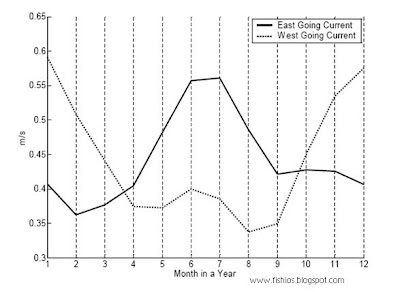
Here is a computed monthly mean current of the tidal stream. (Singapore Maritime & Port Journal 2003, pp.151-162.)


Mean eastward and westward current derived from harmonic stream constituent in each month of a typical year the prediction shows a similar dominant mean westward stream during the northeast monsoon from November to March. The stream represents the net water movement from South China Sea westward into Malacca Strait.


During the southwest monsoon (June – September), the observed water movement is from the Java Sea northward into Singapore Strait, after which the water split into two streams that move westward and eastward into Malacca Strait and South China Sea respectively.


WHEN TO FISH? Wind

Can wind affect fishing?

Besides the more scientific approach and published papers on the various theories of the effects of the environment on fishing, fishermen has been relying on their experiences and 'theories" and "concepts that have been passed down from generation of fishermen.

Here I would attempt to look at the effect of wind on your overall fishing experience.
Have you heard of the saying "when the wind is from the west the fishn at its best. But if the wind is from the east the fish bite the least" ?

If the weather is calm and warm for a certain period of time water is slack for some time and the undisturbed water may suffer from a lack of aeration thus oxygen.
On this note wind is something that should prompt us to pack our gears and head for the waters.

Why? you ask.

Wind blowing on shorelines and structures can inject oxygen molecules into the water these in turn creates waves that can increase the dissolved oxygen level, baitfishes and predators. Baitfishes will tend to feed on the planktons being disturbed by the wind activities. The predators will position themselves at the rear of the baitfish school and hitting on any of these bait that tries to escape.
Waves created will tend to create mud line - for shallow waters and creates a perfect ambush point for the predators to attack any baitfishes.

On windy days I have also notice that bait fish will seek out calmer water. This can be a good thing because we know that the predators will surely be looking for this too.

Wind Prevents light penetration:This allows the bass to come into shallower water to feed.
Look for windy shores, if there appears to be a current running, try to fish upwind if you can. Between boat handling into the wind and casting upwind, this is easier said than done.
If you are luring you would need to keep in touch with your lure on the retrieve, which suggests a fast retrieve on a heavier lure. Wind will make baitfish like Shad more active, select lures which imitate them.

Note that the wind can work in our favor only after we have considered all aspects of safety. It is obvious that on windy days fishing becomes more dangerous than on non-windy days. Would you be able to cast safely, would there be any safety issues at the spot where you intend to fish.. are some of the questions you need to ask yourself before heading out.

For Information on Asia's Surface Wind charts Click Here


FISHING HOOKS

First the definition: A fishing hook is a hook used to catch fish. It may be barbed or barbless. It is usually attached to a fishing line. In general the hook is concealed within the bait or trailed closely behind or within the lure.

I just got back from my regular tackle shop and I saw a group of young anglers looking at the rack for hooks. They looked puzzled and couldn't decide what hooks to use. And usually they will go for the mid range - the one that's the "average size".


Who could blame them there are more than 50,000 different hook designs out there.

Here we try to shed some light on hooks.

Where is a good place to start but from sizing and naming conventions of the major categories of hooks and in fact is a very important part of your tackle because the type of hook you select will make a difference, and hook selection depends on the species of fish being sought.


Parts of a Hook


Fishing hooks come in many shapes and sizes and materials each variety serving a different purpose. Here is a brief overview of the parts that make up a fly-fishing hook.

The Eye is where your leader is threaded
and tied.


The Bend is the part that is curved.


The Shank of the hook is the straight
part that extends from behind the eye to the beginning of the bend.


The Gap is lies between the shank and
point of the hook.


The Barb is what makes a hook stick in a
fishes mouth (or your body parts). Some CnR anglers will remove the barbs before
using. This is to ensure easy de-hooking of the fish.


Hook Sizes- Size does matter


Fishing hooks use a twofold numbering scheme that measures from the smallest hook to the largest hook.

The smallest hook readily available is size 24. This is a hook with a 1/16 of an inch gap and it’s used for tiny fishes such as whiting or Tamban (sardines). As the size number decreases, the width of the hook gap increases, all the way to a size 1. A size 1 hook has a gap about ½ inch in width.


At this point the numbering scheme changes and begins with 1/0 , which is larger in size than a number 1 and goes all the way up to 20/0, the largest commercially made hook.

Don't bother remembering the numbers because there isn't really a standard although most manufacturers should make hooks pretty close to this numbering scheme. Variations still occurs.


For novice angles I would recommend a size 1 up to size 3/0. However a study of the anatomy of the target fish is important to decide upon the best choice of hook.


Types of Hooks:


Hook offset: For Up eyed hooks the shanks require more force and heavier line to set. And must be snelled in order to allow proper setting. On straight-eye hooks, tie directly with your favorite knot.


Besides sizes of hooks you would need to pay attention to the thickness of the hook depending on the target fish.


FURTHER READING

(From the Scientific Catch-and-Release Studies - South Carolina Department of Natural Resources)
Non-offset Circle hooks gut hooked the least number of fish in both studies (sub-adults and adults). Offset Circle hooks were intermediate. J-hooks gut hooked the most fish in both studies.

Despite the fact that offset Circle hooks gut hooked an intermediate number of fish, the largest percentage of these fish died as a result of hooking injuries.

When fishing for adult red drum, Non-offset Circle hooks caught almost 2 times as many fish as J-hooks did. They also gut hooked substantially fewer fish than J-hooks did.

The best hook to use when you will RELEASE some of your red drum is the Non-offset Circle hooks.


Setting The Drag On Your Fishing Rod and Reel

Set the strike drag with the rod securely in a holder. The scale should read between 25 and 33 percent of the unknotted line strength when the drag starts to slip. 30-lb test line (shown above) should have a strike drag setting of between 7.5 and 10 pounds.

If you set the drag on a light-tackle outfit (12-pound test is illustrated above) with the rod tip pointed at the scale (top image), the reading should be about 15 percent of the unknotted line strength. When the rod is in the fighting position (bottom) friction will increase the drag.

THE ALL IMPORTANT BAIT FOR FISHING

Making a lure/bait attractive to a hungry
predator will catch more fish. Here we will try to talk about the all

important and often taken for granted Bait...
Here's a list of some bait that we can explore:

Basically we can classify baits into the following just for the sake of
discussion-

Live or Natural Baits
Dead Baits
Synthetic Pastes (more for Freshies)
Cooked Baits (more for Freshies)


We will look at these baits and explore more about storing and rigging them
for successful catches.


Live or Natural Baits
Live bait, presented
properly, is one of the most effective option available to today's anglers. It's
also one of the best kept secrets to fooling the oldest, and largest of any
species.


Examples:
Crabs, White bait - Tamban (Sardinella albella or the
Sardinella sp.
), Big Eyed Herring, Yellowtail scad (or Selar),Indian
mackerel (or Kembong),Yellowstripe scad (or Kuning),Chacunda Gizzard Shad,Wolf
Herring (or Saitoh), mullet,Whiting, Squid,Cuttlefish, Shrimp, Ragworm,Beachworms,Tubeworms
(sarong worms)


BLOODWORM


Rigging a live prawn is easy. I prefer to use double hook to secure the bait. Try not to hit the dark colored spine of the prawn while implanting the hook. Make sure you see the barb at the other end to ensure the bait will not fall off especially during a cast.


-Page currently under construction more will be
updated soon- Gone fishing

Testing out the Gonefishing's simple rig!


I will be trying out the above rig which has proven to be very good in my previous trips.
Please stay tuned for updates!!!

When to go fishing...

Here's an article for beginners on what is a good time to fish : Click here

But for the "Prime Fishing Times" based on Solunar effects are slightly more detailed .. and I try to make it simple.

Lets divide the fish feeding times into the following;
1. MAJOR FEEDING TIMES
2. Second MAJOR FEEDING TIMES
3. MINOR FEEDING TIMES

MAJOR FEEDING TIME
This happens during the Moon Transit Time. (Refers to the instant that its center crosses an imaginary line in the sky - the observer's meridian - running from north to south. For observers in low to middle latitudes, transit is approximately midway between rise and set, and represents the time at which the body is highest in the sky on any given day)
So when is today's MFT ? Click here Calculate the Moon Transit Time.
Most Major feeding times last from 2 to 2.5 hours

Second MAJOR FEEDING TIME
The Second Major for that 24 hour period will be approximately 12 1/2 hours later.

MINOR FEEDING TIME
Moonrise and Moonset times
Minor feeding times last from 1 to 1.5 hours

Sun and moon rise and set have a direct effect on the feeding activities of fish and game in all parts of the world. There is a definite correlation of feeding activities when the moon is straight overhead, (Moon Transit) and or on the opposite side of the earth.

PEAK TIMES!
When a Solunar Period falls within 30 minutes to an hour of sunrise or sunset you can anticipate great action! When you have a moonrise or moonset during that period the action will be even greater. And, finally, when the above times occur during a NEW or FULL MOON, you can expect the best action of the season!
(How do I know when's FULL MOON?) - Do not be afraid ... look at the bottom of this page for the Current Moon Phase !


WAIT! Some anglers asked me ... why do we need to calculate the Moon Transit time since it's obvious that HIGH TIDE would be where the moon is at it's transit ? Not quite ...
Since the lunar tide-producing force has the greatest effect in producing tides at most places, the tides "follow the Moon." Theoretically, high tide is at the Moon's transit over the meridian and low tide is about six hours later. Actually there is a time lag between the transit and the occurrence of the maximum because particles do not respond instantly to a time-varying force. High tide normally occurs somewhat later, due to factors such as viscosity, friction, and underwater topography.

Queenfish

-under construction-

Fishing at Bedok Jetty


Bedok Jetty

That must be the first fishing spot a new angler will think of and that's for a good reason.
-under construction-

Moon Phase and Fishing


Choosing The Best Fishing Times There really is nothing complicated about this at all; it's just a matter of knowing ahead of time exactly when the sun and moon will rise and set. Fish are most active during 90-minute windows surrounding each of these four daily events; that's 45 minutes before and after these four daily points. Fishing during these four periods will help increase your fishing catch, but if you plan wisely so as to ensure you're at the water's edge on the days of new or full moon, you can use these 'windows' to reel in a catch like you've never done before.


If you have to choose between sunrise/set and moonrise/set, always go with the moon as the moon is the stronger influence. Hunters have always known that fish and game are most active at dawn and dusk--sunrise and sunset--but their activity surrounding moonrise and moonset is less noticeable because these events are likely to occur without e­ffecting any change in the perceived light. The rise and set of a new moon is invisible anyway, and overcast weather often hides the moon. Without prior knowledge of setting and rising times, two of the best fishing times will be missed every day!


CLICK HERE TO GET MOON RISE AND SET TIMES

There is an increase in frequency of big fish catches during the peak moon phases of full and new moon. Specifically, a lot more big muskies, walleyes, and bass were taken right on the scheduled calendar day of both the full or new (dark) moon peak, and continued for a three to five day stretch afterwards. In other words, if the full moon peak is on June 10th, June 10 thru 15 have great potential for trophies.

Fishing Rigs


The Two hook paternoster.

This rig is useful for a wide variety of species, and in its clipped down version will allow baits to be cast a good distance. This rig is an excellent choice for Queenies, KBL and Whiting


The Cable-Car Rig


This rig is very popular for Jetty or Pier fishing where you are on high ground and it basically secures any live bait and allows them to swim freely at about 2-3 feet below surface. This rig targets pelagics (Fish that live in mid-water or close to the surface) like Queenie, Braacuda, Wolf Herring and Barrmundi (KBL).


As you can see, you would first do a cast of your sinker attached to your main line via a swivel. Once that is done all you need to do is to attach your "Cable-Car" .. a live bait rigged onto a hook and leader via a snap-swivel. Let the bait slide down the tightened mainline.


Do note that you need to be dilligently guarding your tackle because during hook-ups you need to strike at the right time to have the hook set in sufficiently. You might want to strike a few times during retrive and fight.


Do not let the line slaken as that will most likely result in a lost fish.

Fishing Reel

No matter what level of experience you have as a fisherman, you will benefit greatly from having the right reel for the job. You can easily learn what you should be using though and improve your skill because of it. There are three different types that you need to consider. These are the casting reel, the fly casting reel and the spin casting reel.

The Bait Casting Reel
These are quite difficult. The line on them is pulled off the rod by the lure's weight. It is then thrust forward in the motion of casting. They provide a device that lays the line evenly across the rotating cylinder that acts like the core of the reel. Without a smooth cast it will cause problems when the line is reeled in. The line can become tangled, too.

The Fly Fishing Reel
In a fly fishing real, you need to insure that it has a drag that is very responsive. Then, you'll need to purchase a reel that can stand the tension and strain put on it by a large fish. These are more expensive reels than other types. Make sure to check to make sure there are no plastic parts on the reel. All metal reels are much more dependable and they make it worth the price.

The Spinning Reel
The closed faced reel is the inexpensive spinning reel. It is also fairly easy to control. This is probably the choice you would make for those who are learning to fish. They have a push button release for casting. They have an opening at the top where the line comes out when you cast. The reel will mount on your rod.

The open faced spinning rod is a more challenging option. It comes in many sizes to fit your needs. The lightest models are excellent for pan fish. Larger choices will help you with game fishing or ocean fishing. The line capacity on these is greater and is serviceable when you are after trout or even salmon. They offer a smooth drag. Although you can start with a closed face, you can improve your skills and move on to the open faced.

If you are only choosing one type of reel, go with a medium speed one. If two, then look for both a low speed and a high speed. Also, you should choose the right reel depending on if you are left handed or right handed. Also, remember that the lighter the line is, the smaller the reel. You'll need to insure that the fishing line and the fishing reel will work together well.

You can get help with learning what type of reel to purchase from the salespeople at the fishing tackle shop.

Go to our tackle shop list for some recommended tackle shops.
All rights reserved. Copyright Fish-Finder-Review.comCopyright Niall Pesci - http://www.fish-finder-review.com

Type of Fishing

Bait Fishing
When bait fishing, the angler hooks live or dead bait and then casts, letting the bait sink. Depending on the game fish the angler intends to catch, he or she then might let the bait sit on bottom, hoping that the bait’s odor attracts fish; jig the bait up and down so that the action attracts fish; or reel the bait in, attempting to entice fish swimming between the bottom and the surface.

Almost every type of freshwater and saltwater game fish may be caught with bait. Live bait is more attractive than dead bait to predatory game fish, which can smell and see the difference. Dead bait, however, is easier for the angler to store and place on the hook. Popular baits in fresh water include worms, crayfish, insect larvae, fish eggs, frogs, and leeches. In salt water, anglers use small, whole fish; pieces of fish; and live crabs and shrimp. Some anglers also chum, which entails throwing additional pieces of dead bait into the water in hope of attracting game fish.

Spin Fishing
Spin fishing involves the use of artificial lures, which spin as the angler reels in the line. Spin-fishing anglers pay close attention to the retrieval speed and the depth of the lure, trying to imitate a game fish’s prey. If a fish strikes the moving lure, it will usually hook itself. When the fish is hooked, bait-casters and spin-casters reel it in and land it with a net or gaff (a sharp, hook-like pole). Lighter fishing rods are used for smaller fish, and heavier rods for bigger fish. It is considered unsporting to use large rods for small fish because a heavier rod tires them quickly and denies them a chance to fight and escape.

Trolling
Anglers troll by motoring or paddling a boat and dragging the bait or lure about 30 m (about 100 ft) behind the stern. At the correct speed, trolling produces a motion in the bait that mimics a live, unhooked fish. The most common use of trolling is in saltwater big-game fishing. Once a fish hits a lure and is hooked, the boat is stopped and the fish is reeled in. Trollers often use electronic depth finders or sonar to locate schools of game fish.


Fly-Fishing
Perhaps the most difficult angling method is fly-fishing. The fly angler uses a rod much longer and lighter than those used for bait and spin fishing. Fly-fishing rods can be 3 m (10 ft) long in freshwater fishing and 4 m (14 ft) long for saltwater fishing. To cast a fly, the angler whisks the fly rod forward and back using only the forearm. Generally, the rod is moved from the 10 o’clock position to the 2 o’clock position without letting the line touch the water or ground. During this movement the angler pays out line. The movement continues until a considerable amount of line is airborne. The angler then casts the line to a specific spot with a sharp but smooth snap of the wrist.

Casts are made to likely fishing spots such as pools and pockets in streams. The fly is allowed to touch the water and either float or sink, depending on the type of fly. This presentation of the fly onto the water is one of fly-fishing’s most difficult aspects, because the angler is attempting to cast in such a way that the line lands smoothly on the water’s surface and the fly appears as natural as possible. After several moments the angler withdraws the fly by pulling a small portion of line then lifting the tip of the rod. The angler then makes another presentation. When fly-fishing, one hand should always be holding the fly line so there is little or no slack. If a fish strikes, the angler pulls in line while raising the rod tip. This sets the hook in the fish’s mouth.

Ice Fishing
Fishing through ice is a popular form of angling in northern regions, where lake surfaces freeze solid. Ice anglers drill holes through the ice, then lower lures or baited hooks into the water. By jigging the lure or bait, or by letting live bait swim freely on the end of the line, the angler hopes to attract game fish. Although ice fishing can be done with regular bait fishing tackle, most enthusiasts prefer ice fishing rods, which are shorter poles with less complicated reels. Many anglers drag lightweight, wooden shacks and plastic or nylon tents onto the ice, to provide protection from the weather.

"Fishing," Microsoft® Encarta® Online Encyclopedia 2007

Fishing Rod Terms and Parts

Action: This describes how much of the rod deflects (bends) when you put pressure on the tip. A fast action rod will bend in only the top third or less of the blank, a medium or moderate action will bend in the top half or so and a slow action will bend starting in the lower third of the rod. Sometimes slow action rods are termed 'parabolic', meaning the bend of the rod is similar throughout the length. This description is subject to the type of rod you may be talking about at the time; a fast action fly rod or steelhead rod will bend much lower and more easily than a fast action bass rod or offshore rod.

Most bass rod actions are fast to very fast because this action generally provides better sensitivity and faster power for hooksetting. By faster power we mean the rod 'shuts off' faster, or the bend ends higher on the blank, which means you don't have to move the rod as far on the hookset to get into the stiffer part of the blank. Fast action rods are great for most applications where a short to long casting distance is involved and single hooks are the rule, such as worm and jig fishing.

Medium and medium-fast rods will usually provide a little more casting distance and still provide adequate hooksetting power. These actions are often used for applications that involve treble hooks, such as crankbaits and topwater lures or other reaction baits such as spinnerbaits. The 'bite' of a treble hook is not as deep as a big single worm hook and it is easier to tear the hook out of a strong fish, plus the slower action will not pull the lure out of the fish's mouth before it fully engulfs it. The type of lure you use will usually determine the action of the rod you should use.

Taper: Often used synonymously with "action", taper describes not only the thickness of the rod but also the thickness of the wall of the blank and where along the blank less material is used allowing more bend. For our purposes taper is the same as action.
Power: This describes the strength of the rod or it's lifting power. When someone says this rod has a lot of backbone, they mean it has a lot of power. Power ratings are usually describes as heavy, medium heavy, medium, etc. Power is closely related to the line strength; heavier power rods will handle heavy line weights and lighter powers will be good for light lines. It is fairly important to keep your line test within the limits printed on the rod since a heavy power rod will snap light lines too easily and heavy lines can snap a light rod. Power ratings vary by the type of rod described; a heavy bass rod and a heavy offshore rod will definitely not feel the same. One might be rated for 25lb line and the other for 80lb line.
The type of water you're fishing will help determine the power of the rod you should select. Thick, heavy cover will require a strong rod to get the fish out before it can tie you up. Clear, open water will often require thin, hard to see lines in order to get bit, meaning you will need a lighter power rod.

Responsiveness: Related to modulus this is an idea that reflects the ability of the entire rod to flex under load and release the stored energy in the cast. As we will see below, a finished rod may be the result of different layers of different material, all of which contributes to the responsiveness of the rod. One thing is for sure, the lighter the rod, especially the tip, the more responsive it will be. As Gary Loomis puts it, weight is the deterrent to performance. Overall, the higher the modulus the more efficiently it will store and release energy, which gives you the ability to flick an accurate cast on a lower trajectory.

Graphite: This is the most common material used in building bass rods today and was first introduced in the 70's by Fenwick. These days graphite is produced using extremely high temperatures in a two-part process, one to create tensile strength and one for stiffness. Temperatures sometimes exceed 3000 degrees! Generally the hotter the furnace in each process the more tensile strength and stiffness the fibers have, which means you need less material to build a rod, and the rods you do build can be lighter and more sensitive.
High tensile strength is sometimes called high strain, and the stiffness is known as tensile modulus or just modulus. To build a rod with high modulus and without high tensile strength creates a brittle rod. That's how some brands can advertise high modulus graphite rods with a cheap price; not all the expensive steps in the graphite making process are completed, giving you an inferior rod.

To reach these extreme temperatures costs a lot of money and the best graphite is very expensive. The parallel graphite fibers created by the heating process are then incorporated into sheets with a resin. You can reduce the cost of materials by using more resin and less graphite, but you end up with a softer rod. You'll need to add more material for a stiffer action, resulting in a heavier, less sensitive rod.

Another layer of fibers is laid onto the sheets of graphite fibers and resin perpendicular to the graphite fibers. This second layer, called the scrim, is almost always fiberglass. The exceptions to this rule are the G. Loomis GLX and the St. Croix SC4 graphite, which incorporate carbon or graphite instead of fiberglass, creating a very expensive and rare material.
The best rods get their specific actions by using a variety of materials, and by using layers of different graphite and/or fiberglass. It's not that difficult to produce a graphite rod, and more and more rods are being built offshore, many in huge plants in China. As we've seen, a material can be called graphite but not exhibit the weight, sensitivity, and toughness that characterizes the best rods on the market today.

Fiberglass: This material has been used to produce rods since the 50's and has come a long way since then. Glass is noted for soft actions and toughness, and is used to build some great rods. Many anglers prefer glass rods for throwing crankbaits or other applications where a medium to slow action is required. Some rods are built with a combination of graphite and glass, enabling rod designers to produce some great actions.

IM6, IM7, etc.: These are trade names for particular graphite produced by the Hexcel Corporation. These numbers are not industry standards or an indication of quality, especially since other companies use the designations to refer to graphite not made by Hexcel. At best, they allow you to compare the quality of the material used to build different rods by the same manufacturer. You can be confident that the IM7 rod would use better graphite than the IM6 rod if both are made by the same manufacturer. It's more difficult to say the same about rods from two different companies, since they could be made from material from completely different manufacturers.

Modulus: As stated above, modulus refers to the stiffness of the graphite, not the amount of material used or the number of graphite fibers incorporated into the sheets. Buying a rod based solely on the modulus rating is a mistake because other factors must be considered. For instance, you don't want the stiffest rod for light line techniques or cranking. In addition, other qualities must be incorporated in the graphite itself and the rod must be designed correctly to ensure the best performance and durability of the rod. The other components that go into a quality rod can also add significantly to the cost.

Guides: Most of the guides you will find on bass rods today feature a metal frame and a ceramic ring that the line glides on. This ring can vary greatly in price, and one single guide on a spinning rod can cost in excess of $30 or as little as a couple of bucks. Silicon carbide, or SiC, is usually considered the best material today. It offers a super smooth surface for less friction on the line during the cast and the retrieve. Less friction means longer casts and less heat, and heat kills when it comes to fishing lines.

Alconite is another smooth material that is much less expensive than SiC. Hardloy, Hialoy, and aluminum oxide are other ceramic materials that are quite serviceable and are found on most rods on the market today. They are very inexpensive. Some of the newest guides feature Titanium wire. These guides will spring back into place even if they are bent flat. Standard stainless steel guides break instead of bending, necessitating expensive and annoying repairs. Some proprietary guides use a ring of stainless steel instead of ceramic. These rings are not nearly as smooth as the ceramic inserts but are very lightweight, reducing the overall weight of the rod.

A rod with more guides on it will generally cast better and cost more than the same rod with fewer guides. With more guides the rod will bend more consistently throughout its length, allowing it to utilize all the power for longer casts and fighting fish. The Fuji Concept Guide System is the best example of this development on rods today.

Cork: You need to have a comfortable and lightweight handle with sufficient grip, even when it's wet, that will transmit the delicate vibrations of a big bass picking your worm, and cork fits the bill perfectly. A nice, new, fresh, clear, high quality cork grip is a beautiful thing! However, the quality of cork varies greatly along with the price. Most rod manufacturers base the grade of cork used in their rods on the overall cost of the rod; you will get the best cork with the most expensive rods.

Reel seats: The reel seat holds the reel on the rod. There isn't much variation in reel seats. Most anglers prefer graphite seats with a cutout that allows you to feel the blank. The cheapest rods will use reel seats that don't have a plastic cushion inside the metal hoods that the feet of the reel fit into. These seats will often rust and stain your reel. They can bind up, too, making it difficult to remove your reel. Cheap rods, particularly those made offshore, will have cardboard spacers between the reel seat and the rod blank that will dampen vibration and can tear easily, especially when it gets wet, allowing the seat and the reel to rotate on the rod; not a good thing!
When you take all these factors into consideration it's easy to see why the best rods cost so much money. This is especially true of modern bass rods, since anglers demand fast, crisp actions, the lightest weight possible, and the ability to take a beating on the deck of your boat, in the rod locker, or in the back of your pickup.

Fishing Gear

Fishing can be fun and a good way to help provide additional fresh sources of food for the family. In Singapore I believe everyone lives near bodies of water, from the ocean, to landlocked bays, to ponds, rivers, lakes, streams etc.
To get started we need to have some gears.. you need not start off with the expensive stuff.

I started off choosing the basic rods and reel. But before deciding which to buy we need to look at several important factors.

Traveling? Need Hotels?

Aseania Resort Pulau Besar is famous for it part as the location and accommodation for filming of Expedition Robinson an European Survivor Series. A wonderful resort great for fishing trips.

Promotions

Readers

Key West Fishing

Follow in the wake of legendary sportsman Ernest Hemingway on a deep sea fishing charter or fish the backcountry with a local flats guide and target permit, bonefish and tarpon, the Silver Kings. Check out the fish photos and see what’s being caught off Bone Island this week.FISH PHOTOS